
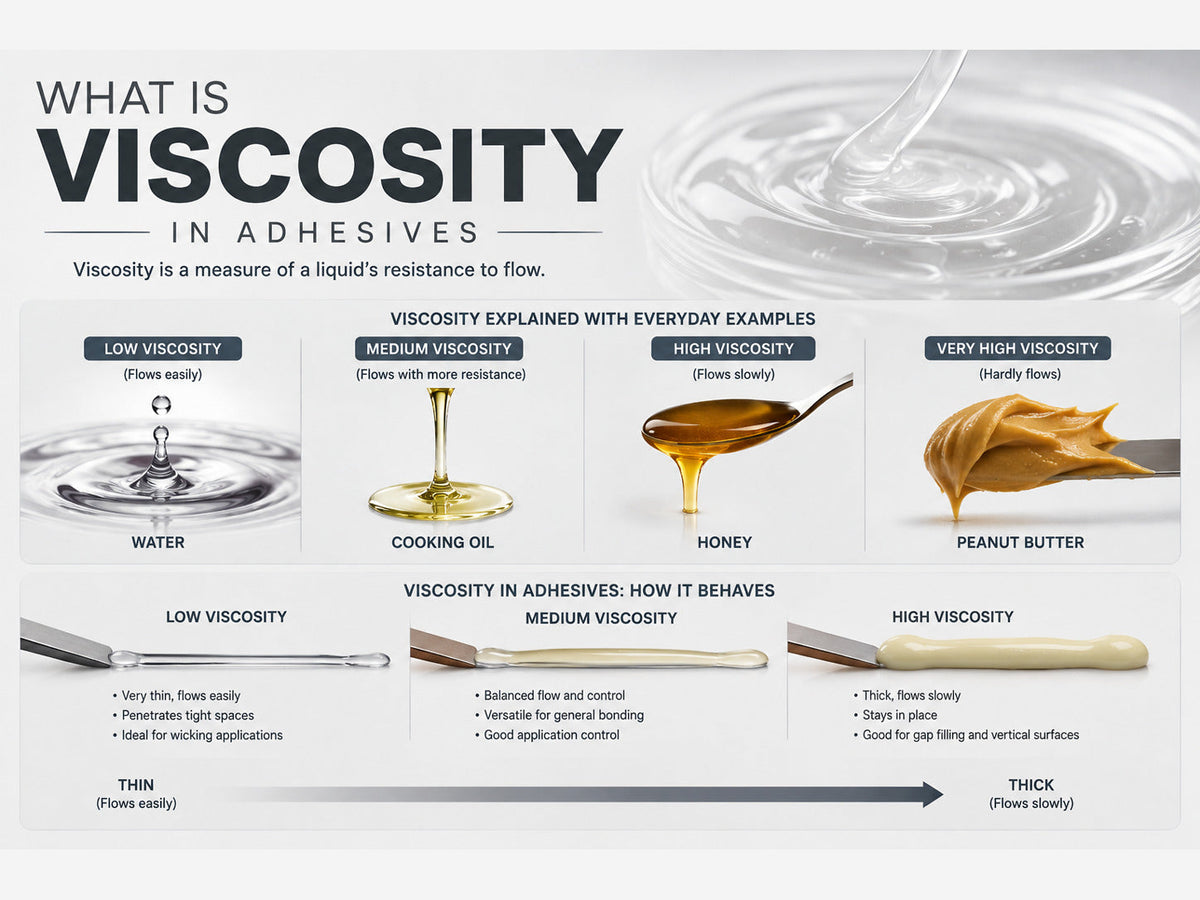
What Is Viscosity in Adhesives?
Adhesive viscosity describes how easily an adhesive flows. It is one of the most important properties to consider when choosing a glue because it affects application, penetration, gap filling, dispensing, and how well the adhesive stays where it is applied.
In simple terms:
-
Low viscosity = thin and flows easily
-
High viscosity = thick and flows slowly
But higher viscosity does not automatically mean a stronger adhesive.
Understanding Viscosity with Everyday Examples
Think about familiar liquids:
Water → Cooking oil → Honey → Peanut butter
As you move from water toward honey, resistance to flow increases.
Adhesives behave similarly.
How Is Adhesive Viscosity Measured?
Viscosity is commonly expressed in centipedes cps or MPS.
As a simple reference:
| Material | Approximate Viscosity |
|---|---|
| Water | ~1 cps |
| Light oil | Tens of cps |
| Syrup | Thousands of cps |
| Honey | Several thousand cps or higher |
These are only everyday references. Actual values vary significantly with material and temperature.
Why Does Viscosity Matter in Adhesive Selection?
The right viscosity depends on how and where the adhesive needs to move before it cures.
Think of it this way:
-
Tight joint → lower viscosity → better penetration
-
General bonding → medium viscosity → balance of flow and control
-
Larger gap → higher viscosity → better placement and gap control
However, viscosity should never be considered alone. Surface energy, wetting, cure mechanism, bond-line thickness, temperature, substrate porosity, and adhesive chemistry can all affect the final bond.
Viscosity vs. Thixotropy(Sagging): Not the Same Thing
This distinction is particularly important.
A high-viscosity adhesive is simply resistant to flow.
A thixotropic adhesive changes its flow behaviour under shear, for example, while being mixed, spread, pumped, or dispensed and rebuilds its structure when that force is removed.
Therefore:
High viscosity does not necessarily mean non-sag.
An adhesive can be very thick but still slowly sag down a vertical surface. A properly thixotropic adhesive can flow during application and then remain much more stable after application.
Temperature Also Changes Viscosity
Most liquid adhesives become less viscous as temperature increases and more viscous as temperature decreases.
Think about honey: refrigerated honey flows slowly, while warm honey flows much more easily.
Adhesives can behave similarly.
This is why viscosity specifications should normally be associated with a defined test temperature.
Does Higher Viscosity Mean Stronger Adhesion?
No.
Viscosity primarily describes flow behaviour, not ultimate bond strength.
A thin adhesive can produce an extremely strong bond when it properly wets and penetrates a close-fitting joint. A very thick adhesive may perform poorly if it cannot adequately wet the substrate.
The goal is therefore not to choose the highest viscosity, but to choose the right viscosity for the application.
Key Takeaway
Viscosity tells us how easily an adhesive flows.
-
Low viscosity provides penetration and wicking.
-
Medium viscosity provides a balance of flow and control.
-
High viscosity provides greater placement and gap control.
The best adhesive viscosity is the one that allows the adhesive to reach the bonding area, properly wet the surfaces, maintain the required bond line, and remain where it is needed until cure occurs.
Related Products
Explore All CECCORP Adhesive Products


