
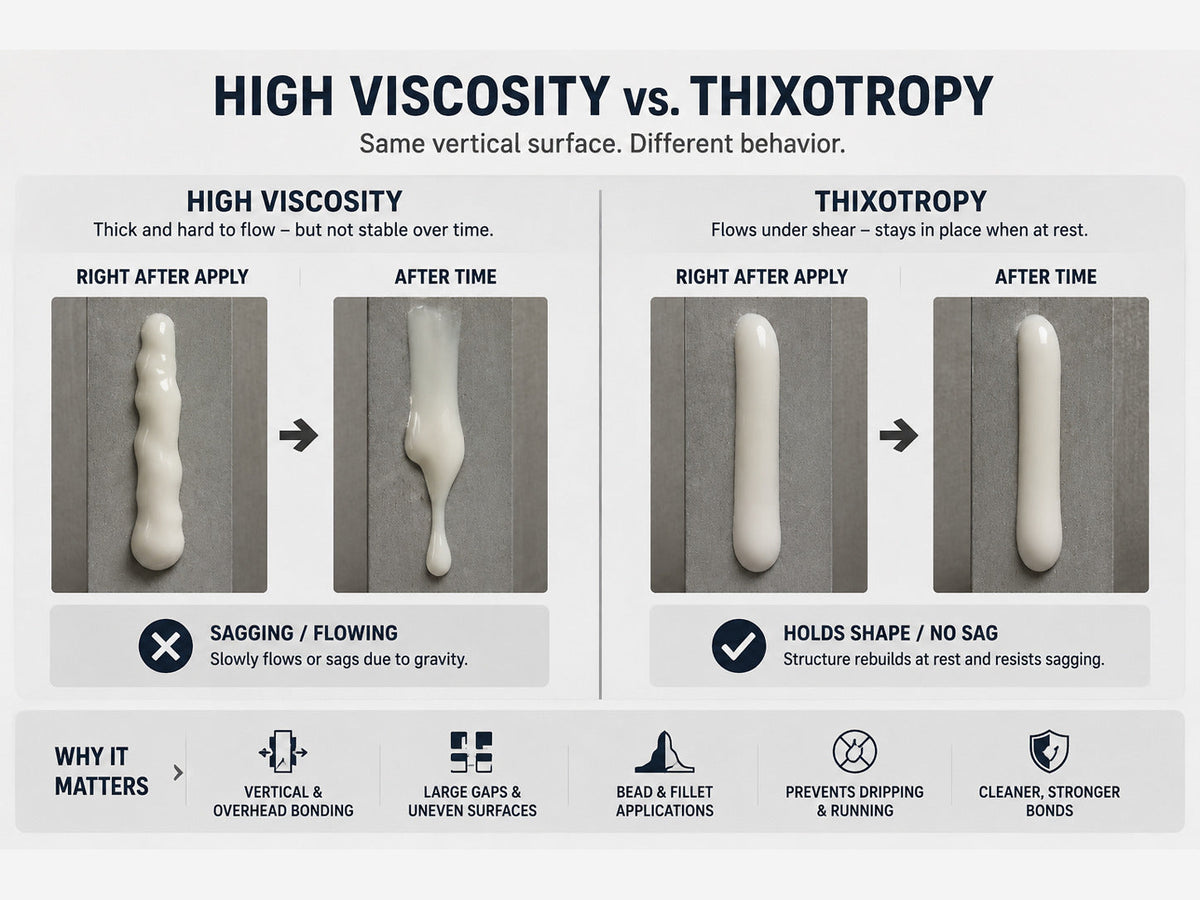
When choosing an adhesive, viscosity and thixotropy are often confused. Both affect how an adhesive flows and stays in place, but they describe different properties.
Understanding the difference can help you select the right adhesive for vertical bonding, gap filling, precise dispensing, and general assembly applications.
What Is Viscosity?
Viscosity is a measure of a liquid’s resistance to flow.
Simply put:
-
A low viscosity adhesive flows easily and can penetrate small gaps.
-
A high viscosity adhesive is thicker and flows more slowly.
For example, a thin CA glue can wick into a tight joint, while a high viscosity CA glue stays closer to where it is applied and can accommodate somewhat larger gaps.
Viscosity is commonly reported in centipoise (cP or mPa·s).
However, viscosity alone does not tell you everything about how an adhesive will behave after application.
What Is Thixotropy?
Thixotropy describes how an adhesive’s viscosity changes when it is subjected to movement or shear.
A thixotropic adhesive becomes easier to flow while it is being mixed, pumped, spread, or dispensed, but becomes thicker again when the movement stops.
This creates an important practical advantage:
Easy to apply → stays where you put it.
For this reason, thixotropic adhesives are particularly useful for:
-
Vertical surfaces
-
Overhead applications
-
Large gaps
-
Bead applications
-
Fillets
-
Bonding uneven surfaces
-
Applications where dripping, running, or sagging must be minimized
High Viscosity Does Not Always Mean Non Sag
This is the key difference.
A high viscosity adhesive may simply be very thick. It can be harder to dispense or spread, yet it may still slowly flow or sag after application.
A thixotropic adhesive, on the other hand, is formulated to flow more readily when force is applied and then recover its structure after dispensing.
For example, imagine two epoxy adhesives that appear equally thick in their containers.
Adhesive A: High viscosity but relatively low thixotropy
It is difficult to dispense but may slowly level or sag after application.
Adhesive B: Strongly thixotropic
It flows more easily through the mixer or nozzle under pressure but quickly develops enough body after dispensing to resist sagging.
This is why two adhesives with similar viscosity specifications can behave very differently in actual use.
Which One Should You Choose?
Choose based on the application rather than simply looking for the highest viscosity.
High viscosity can be useful when you need a thicker adhesive with limited flow or better gap filling capability.
High thixotropy becomes especially important when you need the adhesive to stay in position after application, particularly on vertical or overhead surfaces.
For many structural bonding applications, the ideal adhesive combines appropriate viscosity with controlled thixotropic behaviour, making it easy enough to dispense and spread while providing good sag resistance after application.
The Bottom Line
Viscosity tells you how resistant an adhesive is to flow. Thixotropy tells you how that flow behaviour changes during and after application.
So when selecting an adhesive, don’t ask only:
“How thick is it?”
Also ask:
“How does it behave when I dispense it, and what happens after I stop?”
That distinction can make a significant difference in adhesive application, gap filling, bead stability, and overall bonding performance.
Related Products
Explore All CECCORP Adhesive Products

1 comment
John Meyers
Love these products with good info support — and BUY CANADIAN!