
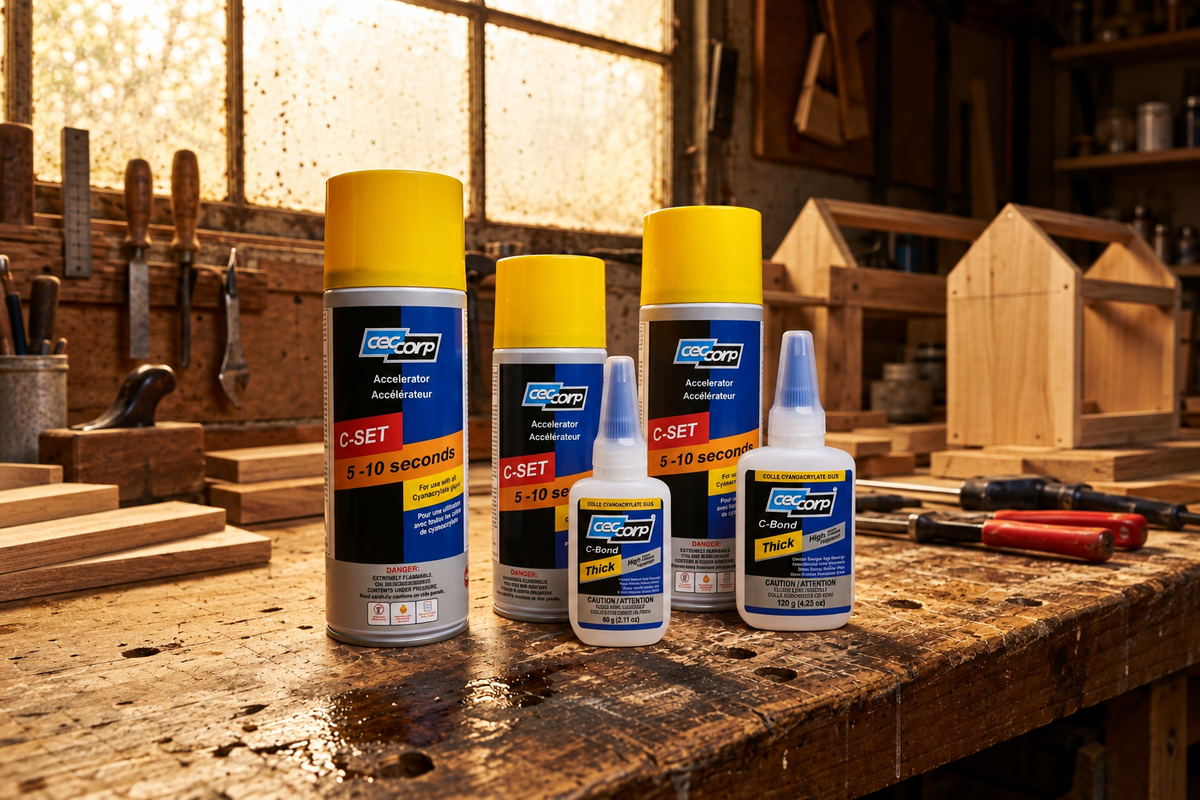
CA Glue Accelerator: How and When to Use Super Glue Accelerator
CA glue accelerator, also known as cyanoacrylate accelerator, super glue accelerator, CA activator, or instant glue activator, is designed to speed up the curing of cyanoacrylate (CA) adhesives.
CA glue already cures quickly, but cure speed depends on the materials being bonded, temperature, humidity, adhesive thickness, and the amount of moisture available on the surfaces. In some woodworking, construction, manufacturing, repair, and assembly applications, waiting even 20–60 seconds for the adhesive to develop handling strength can slow down the job.
A properly used CA accelerator can reduce that waiting time dramatically and allow parts to be positioned, bonded, and handled almost immediately.
What Does CA Glue Accelerator Do?
Cyanoacrylate adhesives cure through a rapid polymerization reaction initiated by moisture and other active species on the bonding surfaces.
A CA accelerator provides chemicals that help initiate and accelerate this curing process.
The result can be:
-
Faster fixture time
-
Faster handling of assembled parts
-
Less time holding components together
-
Improved productivity during repetitive assembly
-
Faster curing on slow or difficult surfaces
-
Rapid curing of exposed or excess CA glue
Accelerator does not simply make CA glue “stronger.” Its main purpose is to make the adhesive cure faster and more predictably when rapid fixture is important.
When Should You Use CA Glue Accelerator?
You do not need accelerator every time you use super glue.
For small, close fitting parts that already bond within a few seconds, allowing the CA glue to cure naturally is often preferable.
Accelerator becomes particularly useful when the application requires very fast positioning and handling, especially when manually holding or clamping the parts would be inconvenient.
Common examples include:
Miter Joints
CA glue and accelerator are extremely useful for quickly assembling miter joints.
Apply a small amount of CA glue to one surface and accelerator to the mating surface. Position the pieces carefully and bring them together.
The joint can fixture almost immediately.
This technique is useful for:
-
Picture frames
-
Decorative trim
-
Small boxes
-
Furniture components
-
Cabinet trim
-
Architectural woodworking
Because the reaction is extremely fast, make sure the joint is correctly aligned before the surfaces make contact.
Crown Moulding and Trim Installation
One of the most practical uses of CA glue accelerator is installing crown moulding, baseboards, decorative mouldings, returns, and trim pieces.
Small outside corners and returns can be frustrating to hold in position while conventional adhesives cure.
CA glue combined with accelerator can create a rapid temporary or permanent bond, depending on the joint design and service requirements.
For example:
Surface A → CA glue
Surface B → CA accelerator
Bring the moulding pieces together and hold them in the correct position briefly.
This can be particularly useful for small crown moulding returns where clamps are difficult or impossible to use.
Cabinet Making
Cabinet makers can use CA glue and accelerator for numerous assembly and installation tasks, including:
-
Attaching small trim components
-
Positioning mouldings
-
Holding parts during assembly
-
Installing decorative components
-
Temporary positioning before mechanical fastening
-
Creating jigs and fixtures
-
Fast repairs and adjustments
For example, a cabinet maker can use several small drops of CA glue to hold a component in its exact position while screws, nails, or another structural adhesive provide the primary long term attachment.
This is sometimes referred to as using CA as an instant positioning adhesive.
Jigs, Templates, and Temporary Positioning
Woodworkers frequently need to temporarily attach templates, fences, stops, blocks, or guides.
CA glue and accelerator can make this process much faster.
Instead of waiting for conventional adhesive to dry, the component can often be fixed in position within seconds.
This is especially valuable in production woodworking, where repeated clamping and waiting can significantly reduce productivity.
Difficult or Slow Curing Surfaces
Some materials cause cyanoacrylate adhesives to cure more slowly than others.
Low temperature, very dry conditions, acidic surfaces, certain woods, and some difficult substrates can increase fixture time.
A compatible CA accelerator can help initiate the curing reaction and provide more predictable fixture times.
However, accelerator does not solve every adhesion problem. If CA glue does not properly wet or adhere to a particular material, making it cure faster will not necessarily produce a stronger bond.
For difficult plastics such as polyethylene (PE) and polypropylene (PP), for example, appropriate surface treatment, primer, or a different adhesive technology may be required.
Three Ways to Use CA Accelerator
1. Accelerator on One Surface, CA Glue on the Other
This is one of the best methods for fast assembly.
Apply CA glue to one mating surface and a light application of accelerator to the other.
Allow excess accelerator solvent to flash off if required by the product instructions, then bring the surfaces together.
This method is excellent for miter joints, crown moulding, cabinet trim, and repetitive assembly.
2. Assemble First, Then Apply Accelerator
Apply the CA glue, position the components, and then apply a small amount of accelerator around the accessible bond area.
This is useful when you want some positioning time before triggering a faster cure.
It can also help cure exposed CA around the joint.
3. Accelerator Before Applying CA
Accelerator can sometimes be applied to a surface before the CA adhesive.
This technique is useful on substrates where CA normally cures slowly.
However, excessive accelerator can cause the adhesive to polymerize too rapidly before it properly wets the surface.
Use only the amount necessary.
More Accelerator Is Not Better
One of the most common mistakes is using too much CA accelerator.
A heavy application can cause the cyanoacrylate to cure extremely rapidly.
Excessively fast polymerization can generate more heat and may result in:
-
A more brittle adhesive layer
-
Reduced opportunity for proper wetting
-
Whitening or blooming around the joint
-
Surface discoloration on some materials or finishes
-
A rough or uneven cured surface
The objective is not to create the fastest possible reaction.
The objective is to create a fast, controlled, and reliable bond.
A light application is normally sufficient.
Accelerator and CA Glue Viscosity(CA Glue & Accelerator Bundle)
The viscosity of the CA glue also affects how accelerator should be used.
Thin CA glue (Shop C-Bond Thin) flows rapidly into very tight joints and porous materials. Accelerator should be used carefully because the adhesive can cure almost instantly.
Medium CA glue provides more positioning control and is a practical choice for many woodworking, cabinet, and trim applications.
Thick CA glue (Shop C-Bond Thick) provides better gap filling and generally gives the user more control during assembly. Accelerator can be particularly useful when a thicker layer would otherwise require longer to reach handling strength.
The correct combination depends on joint fit, gap size, working time, and application method.
CA Accelerator for Gap Filling (C-SET Accelerator)
Accelerator can also help when CA adhesive is being used to fill small cracks, knots, defects, or voids.
For deeper repairs, it is usually better to build the adhesive in controlled layers rather than filling a large cavity with CA and heavily spraying accelerator.
Apply a controlled amount of adhesive, cure the layer, and repeat when necessary.
This reduces excessive heat generation and provides better control over the repair.
For large gaps or structural repairs, epoxy adhesive may be a more appropriate technology than CA glue.
Does Accelerator Make Super Glue Stronger?
Not necessarily.
Accelerator primarily affects cure speed, not the fundamental adhesion capability of the CA formulation.
In fact, forcing CA to cure excessively fast can sometimes produce a more brittle bond or reduce performance compared with a properly controlled natural cure.
If maximum bond strength is more important than immediate handling, allowing the adhesive to cure normally may be the better option.
CA Glue With Accelerator vs. CA Glue Without Accelerator
Use CA glue without accelerator when you have enough natural fixture time, need more positioning time, or want to avoid an unnecessarily aggressive cure.
Use CA glue with accelerator when you need rapid handling, cannot conveniently clamp the parts, are performing repetitive assembly, or are working with a surface where CA cures unusually slowly.
A simple way to remember it is:
Need positioning time → Let CA cure naturally.
Need immediate fixture → Consider CA accelerator.
Important Application Tip
Always test CA glue and accelerator on scrap material before using them on a finished component.
Accelerators contain active ingredients and carrier solvents that may affect certain plastics, paints, stains, coatings, lacquers, or delicate wood finishes.
Testing becomes particularly important when working with finished cabinetry, decorative mouldings, or visible furniture surfaces.
Final Recommendation
CA glue accelerator is a valuable tool when speed and productivity matter, but it should be used selectively rather than automatically.
For woodworking applications such as miter joints, crown moulding, cabinet making, trim installation, jigs, templates, and quick repairs, the combination of CA glue and accelerator can eliminate lengthy holding or clamping times and make assembly significantly faster.
The key is controlled use:
Apply the right CA viscosity + use a small amount of accelerator + align the parts correctly + allow sufficient final cure before placing the joint under full load.
Used correctly, CA accelerator turns an already fast adhesive into an extremely efficient assembly system without sacrificing the control needed for professional woodworking.
Related Products
Explore CECCORP CA Glue / Super Glue Products
Explore CECCORP C-SET CA Glue Accelerator
Explore CECCORP Super Glue Thick & Accelerator
Explore CECCORP Super Glue (CA Glue) & Accelerator
Explore CECCORP Woodturning & Finishing CA Glue Bundle


