
Epoxy Glue for Woodworking: When to Use Epoxy Instead of Traditional PVA Wood Glue
Epoxy glue is a strong and versatile adhesive for woodworking, particularly when a project requires gap filling, bonding different materials, moisture resistance, or reliable adhesion where traditional wood glue may not be the best choice.
From furniture and structural assemblies to knife handles, wooden bowls, repairs, restoration, and wood to metal bonding, epoxy adhesives can solve many challenging woodworking problems.
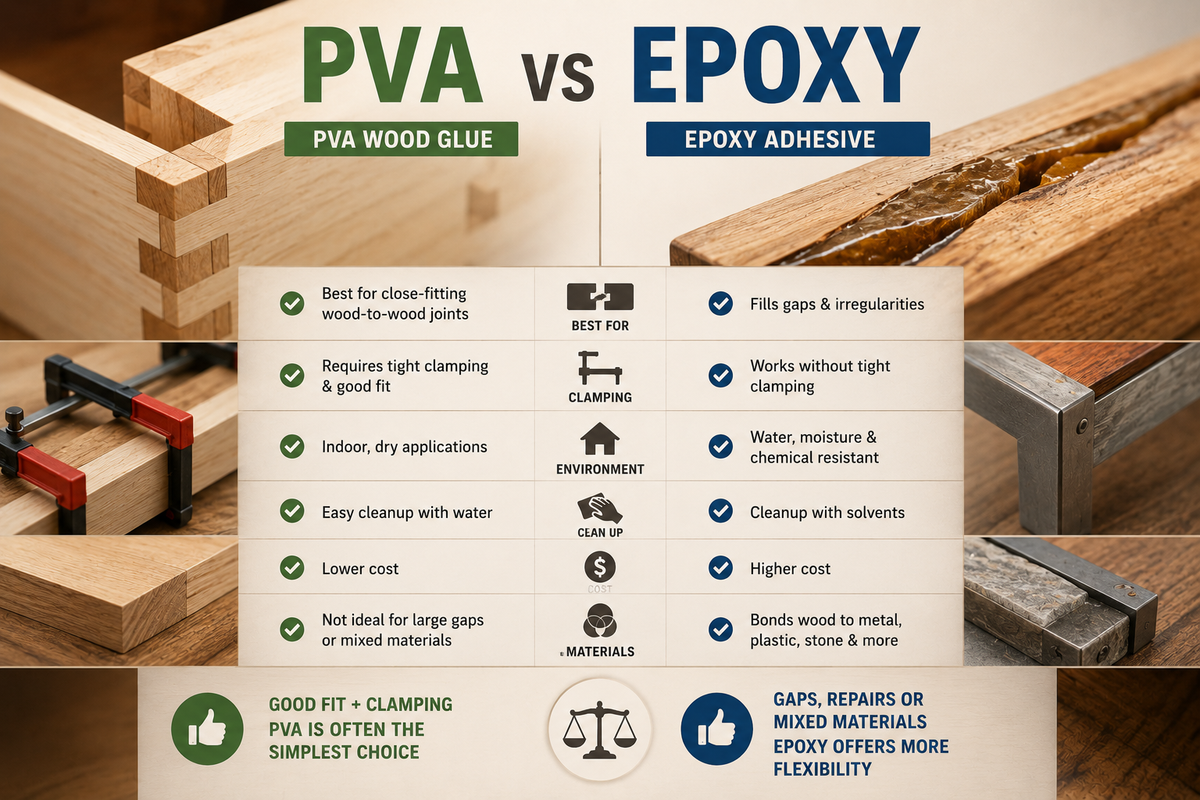
Traditional PVA Wood Glue vs. Epoxy Glue
Traditional PVA (polyvinyl acetate) wood glue is still an excellent choice for many woodworking applications. For properly prepared, close fitting wood to wood joints, PVA is economical, easy to use, and can produce very strong bonds.
However, PVA and epoxy work differently.
PVA wood glue works best when two clean wooden surfaces fit closely together and can be properly clamped. It is not designed to compensate for large gaps, and its performance depends significantly on good contact with the wood.
Epoxy is a two component reactive adhesive. After the resin and hardener are mixed, they chemically cure into a solid material. This allows epoxy to maintain useful strength even in thicker bond lines and gaps.
When PVA Wood Glue Makes Sense
Traditional PVA is usually a good choice for:
-
Close-fitting wood to wood joints
-
Furniture and cabinet assembly
-
Edge and face laminating
-
Joinery that can be properly clamped
-
General indoor woodworking
-
Applications where low cost and easy cleanup are priorities
For a well designed wood joint, there is often no reason to replace a good PVA adhesive with epoxy.
When Epoxy Glue Has an Advantage
Epoxy becomes particularly useful when:
-
The joint contains gaps or irregularities
-
Damaged wood needs to be rebuilt or repaired
-
Wood must be bonded to metal, fiberglass, composites, stone, ceramic, or other materials
-
Longer working and positioning time is required
-
The joint cannot be clamped tightly
-
Better moisture or environmental resistance is needed
-
The wood is dense, difficult, or oily
-
A thick, non-sag adhesive is required
In simple terms:
Good-fitting wood + proper clamping → PVA is often the simplest choice.
Gaps, difficult joints, repairs, or mixed materials → Epoxy often provides more flexibility.
Gap Filling and Wood Repair
One of epoxy’s biggest advantages in woodworking is its gap filling capability.
Traditional PVA should not normally be used simply to fill a poorly fitting joint. Epoxy can be formulated with different viscosities and thixotropy, allowing it to fill cracks, voids, and irregular joints while maintaining a continuous adhesive layer.
Epoxy is therefore useful for furniture restoration, damaged joints, cracks, knots, missing wood, and structural repairs.
Bonding Wood to Other Materials
Woodworking increasingly involves combinations of different materials.
Epoxy can be used for applications such as:
-
Wood to metal: Furniture hardware, knife handles, and decorative components
-
Wood to fiberglass or composites: Marine and specialty projects
-
Wood to stone or ceramic: Furniture and decorative assemblies
-
Wood to compatible plastics: Custom and mixed material fabrication
This versatility is one of the major differences between epoxy and conventional PVA wood glue.
Epoxy for Knife Handles and Tool Handles
Epoxy is commonly used for bonding wooden knife scales and tool handles to metal.
The adhesive can compensate for small machining tolerances while providing strong contact between the two different materials. Toughened epoxy systems can also provide improved resistance to impact, vibration, and repeated mechanical stresses.
Working With Dense and Oily Woods
Exotic woods such as teak, rosewood, and cocobolo may contain natural oils and extractives that make bonding more difficult.
Fresh sanding and appropriate surface cleaning immediately before bonding can significantly improve results. Selecting an epoxy designed for difficult substrates can provide another option when conventional woodworking adhesives do not provide sufficient reliability.
Choosing the Right Epoxy Cure Speed
Different woodworking projects require different working times.
-
Fast-setting epoxy: Small repairs and quick assembly: C‑Poxy 5 and C‑Poxy 15
-
Medium-cure epoxy: General woodworking, furniture, and moderately complex assemblies: C‑Poxy 30
-
Slow-cure epoxy : Larger structures, complicated positioning, deep repairs, and projects requiring extended working time: C‑Tough
The fastest epoxy is not necessarily the best woodworking epoxy. The goal is to select enough working time, viscosity, gap-filling ability, and final strength for the particular joint.
PVA, CA Glue, or Epoxy?
Professional woodworkers often use all three because each adhesive solves a different problem.
PVA glue is excellent for traditional, close-fitting wood-to-wood joinery.
CA glue (cyanoacrylate) is ideal for fast repairs, small parts, stabilization, fine cracks, inlays, and many woodturning applications.
Epoxy glue is particularly valuable for gap filling, demanding repairs, structural applications, and bonding wood to other materials.
Rather than asking which adhesive is universally stronger or better, the more useful question is:
Which adhesive technology best matches the wood, joint design, bond line thickness, working time, and service conditions of the project?
Related Products
Explore CECCORP Epoxy Adhesive Products

