
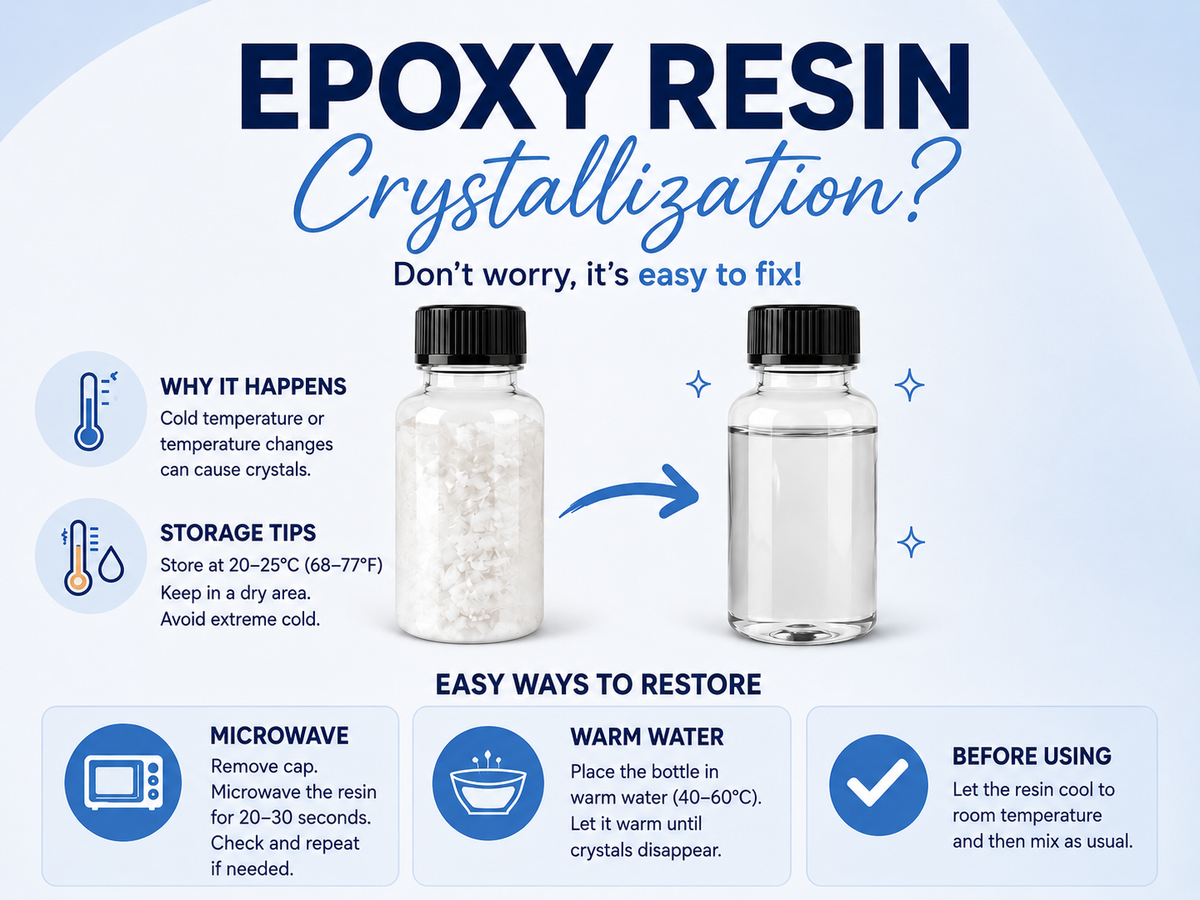
Epoxy Resin Crystallization: Why It Happens and How to Restore It
If the resin side of your epoxy becomes cloudy, grainy, thick, or even partly solid, it does not necessarily mean the epoxy has gone bad. In many cases, the resin has simply crystallized.
Crystallization is a physical change in the epoxy resin and is often completely reversible with gentle heating.
What Does Crystallized Epoxy Look Like?
Depending on the degree of crystallization, you may notice:
- A cloudy or milky appearance
- Small white crystals
- A grainy or sugary texture
- Unusually high viscosity
- Part or all of the resin becoming semi-solid or solid
This is different from cured epoxy. A crystallized resin can normally be returned to its original liquid condition.
Why Does Epoxy Resin Crystallize?
Many liquid epoxy resins, particularly Bisphenol-A and Bisphenol-F based epoxy resins, can crystallize under certain storage conditions.
Several factors can contribute:
Storage temperature: Cool temperatures and repeated temperature changes can encourage crystallization. Storing epoxy in a cold garage, warehouse, vehicle, or near an exterior wall during winter can increase the possibility.
Temperature cycling: Repeated movement between warm and cold environments may promote crystal formation.
Storage time: Crystallization may occasionally occur after extended storage, even when the resin is still chemically usable.
Humidity: Humidity itself is generally not a primary cause of epoxy resin crystallization because the resin is stored in a closed container. However, containers should always be kept tightly sealed to prevent moisture or contamination from entering the product.
Recommended Storage
For most room-temperature epoxy adhesives, store the product in a dry, stable indoor environment at approximately 20–25°C (68–77°F) unless the product’s technical data specifies otherwise.
Avoid prolonged cold storage and unnecessary temperature cycling.
How to Restore Crystallized Epoxy Resin
The solution is usually simple: heat the resin gently until the crystals completely dissolve.
Quick Method for Small Bottles
For a small microwave-safe plastic bottle containing only the resin component, warming it briefly in a microwave may help.
Start with a short heating interval, such as 10–20 seconds, check the resin, and repeat only if necessary. A total of around 20–30 seconds may be enough for some small bottles, depending on bottle size, resin quantity, and microwave power.
Important: Remove the cap or loosen it as appropriate to avoid pressure buildup, and never microwave metal containers, containers with metallic parts or foil seals, or the mixed resin and hardener. Avoid overheating.
Because microwave heating can be uneven, a warm-water bath is the preferred and more controlled method.
Warm-Water Method
Place the tightly closed resin bottle in warm water, typically around 40–60°C (104–140°F).
Allow the resin to warm gradually and occasionally turn or gently agitate the bottle. Continue until:
the resin becomes completely clear and uniform and no crystals remain.
Larger containers or heavily crystallized resin may require more time.
Before Using the Epoxy
After all crystals have disappeared, allow the resin to cool back to room temperature before mixing it with the hardener.
Do not judge the mixing ratio while the resin is still unusually hot because heating significantly lowers epoxy viscosity.
Easy Rule to Remember
Crystallized epoxy resin does not automatically mean damaged epoxy.
Crystals → Warm the resin → Dissolve completely → Cool to room temperature → Use normally
In most cases, properly restored epoxy resin will return to its normal appearance and performance.
How to Help Prevent Crystallization
Keep epoxy resin:
- At a reasonably stable room temperature
- Away from prolonged cold conditions
- Away from repeated heating and cooling cycles
- In its original, tightly closed container
- In a clean, dry storage area
If your epoxy resin looks cloudy or solid after cold storage, don’t immediately throw it away. Gentle warming may be all it needs to return to normal.
Related Products


