
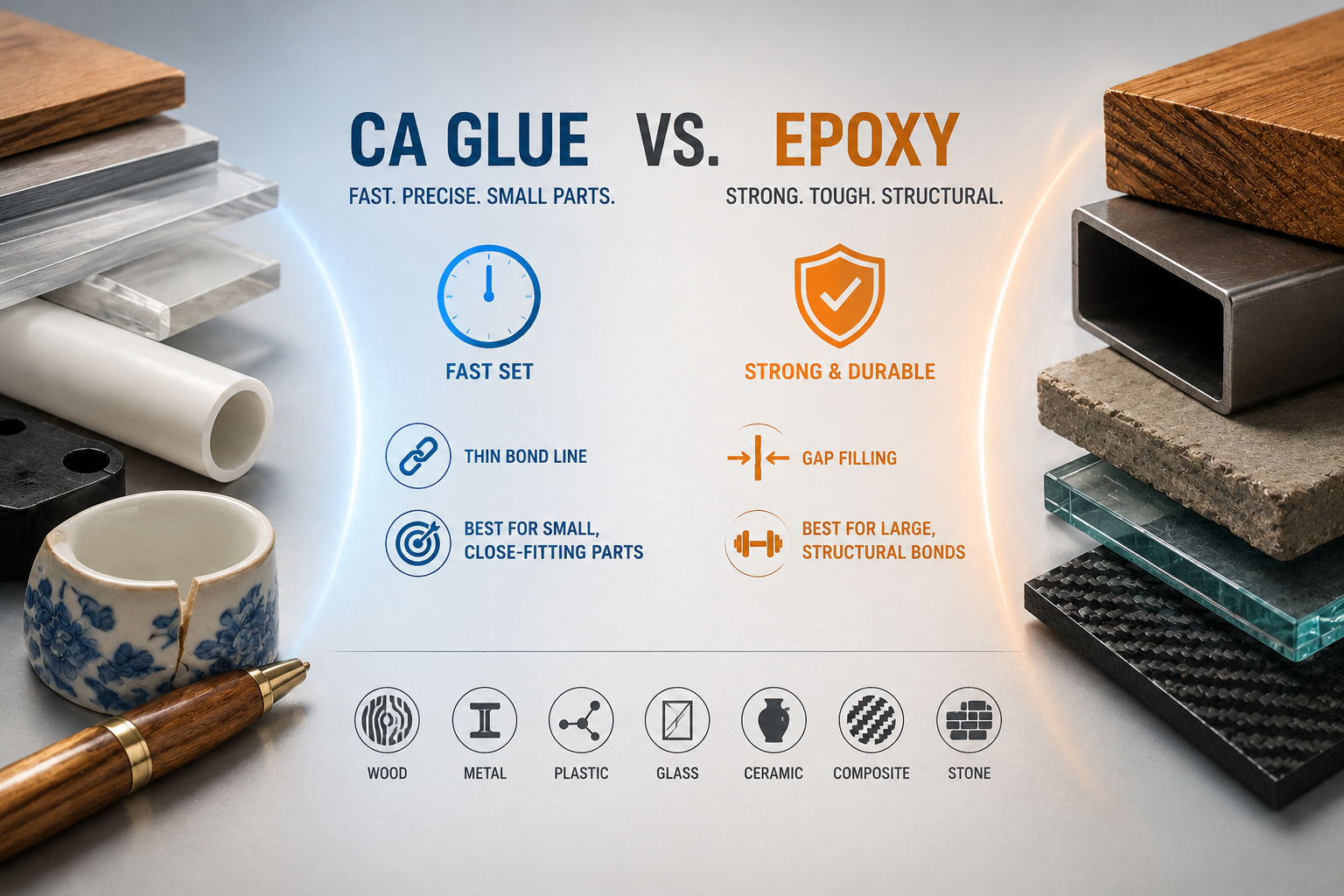
Both CA glue (cyanoacrylate) and epoxy adhesive can create strong bonds, but they work very differently. The better choice depends on the surface material, size of the parts, bond gap, required working time, flexibility, and service conditions.
A simple way to think about it:
CA glue = fast bonding for small, close-fitting parts
Epoxy = stronger gap filling and structural bonding for larger or demanding assemblies
CA Glue vs. Epoxy at a Glance
Wood
CA glue works extremely well for many woodworking applications because it penetrates wood pores and cures rapidly.
It is especially useful for:
-
Wood turning
-
Wooden pens
-
Small repairs
-
Crack stabilization
-
Inlays
-
Filling small knots and voids
-
Bonding small wooden components
Different CA viscosities can also be selected for different jobs. Thin CA can wick into fine cracks, while medium and thick CA provide better control and some gap filling.
Epoxy
Epoxy is usually better when the joint is larger, structural, irregular, or contains significant gaps.
Typical applications include furniture construction, timber repair, large cracks and voids, wood-to-metal bonding, knife handles, and structural assemblies.
Small, fast wood repair → CA glue
Large, structural or gap-filling wood bond → Epoxy
Steel and Stainless Steel
Both adhesives can bond metals, but their strengths are different.
CA glue can produce surprisingly strong bonds between small, accurately fitting metal components. Because the adhesive layer is normally thin, it is ideal when rapid fixture is important.
Epoxy is generally preferred for larger or structural metal assemblies because toughened structural epoxies provide better impact resistance, gap filling, and long-term load capability.
Small close-fitting metal parts → CA
Structural metal bonding → Epoxy
Proper cleaning and surface preparation can significantly improve the performance of either adhesive.
Aluminum
CA adhesives can bond aluminum very effectively, particularly for small components with tight bond lines.
For larger aluminum parts, structural assemblies, or applications exposed to vibration and impact, a toughened epoxy adhesive is generally the better choice.
Epoxy also provides more flexibility in controlling bond-line thickness and filling machining or assembly tolerances.
Plastics
This is where adhesive selection becomes more complicated because there is no single material called simply “plastic.”
ABS, PVC and Many Engineering Plastics
CA glue is often an excellent choice for small plastic components because it provides:
fast cure + thin bond lines + high strength
Epoxy becomes attractive when the plastic parts are larger, have gaps, or require additional impact resistance.
However, compatibility should always be tested because some plastics can be sensitive to adhesive chemistry.
HDPE and PP
Polypropylene (PP) and polyethylene materials such as HDPE are difficult to bond with both standard CA glue and standard epoxy.
Their very low surface energy prevents many conventional adhesives from properly wetting and adhering to the surface.
These materials normally require:
-
A specialized CA plus primer,
-
A specially formulated low surface energy structural adhesive, or
-
Another adhesive specifically designed for polyolefins.
Simply changing from CA to ordinary epoxy usually does not solve the problem.
Fiberglass
For most fiberglass repairs and structural bonding, epoxy is the stronger overall choice.
Epoxy works particularly well when bonding:
-
Fiberglass to fiberglass
-
Fiberglass to metal
-
Fiberglass to wood
-
Composite structures
-
Larger damaged areas
CA can still be useful for small repairs, positioning components, or rapid assembly, but epoxy is generally preferred when structural performance is required.
Carbon Fiber and Other Composites
Epoxy is usually the preferred adhesive for structural composite bonding.
A properly formulated structural epoxy can provide excellent adhesion while distributing stress over a larger bonding area.
CA is more appropriate for small components, temporary positioning, edge repairs, or non-structural assembly.
Structural carbon-fiber bonding → Epoxy
Ceramic and Stone
CA glue works extremely well for many small ceramic and stone repairs, particularly when the broken pieces fit closely together.
For larger gaps, missing material, uneven surfaces, or heavier pieces, epoxy usually performs better.
Epoxy can also be formulated as a non sag or putty grade adhesive, making it useful for vertical stone and ceramic repairs.
Clean, close-fitting break → CA
Large repair or significant gap → Epoxy
Rubber
Flexible CA adhesives can be particularly effective for bonding many types of rubber.
Standard rigid CA may create a bond that is too stiff for highly flexible components, so a rubber toughened or flexible CA is often preferable.
Epoxy is generally less suitable when the rubber must continue stretching or flexing significantly.
What About Gaps?
This is one of the biggest differences between CA and epoxy.
CA adhesives generally perform best with thin bond lines and closely fitting surfaces, although thicker and gel CA formulations can handle somewhat larger gaps.
Epoxy is naturally much better suited to:
uneven surfaces + larger gaps + structural bond lines
This makes epoxy particularly useful when components do not fit perfectly.
Speed vs. Working Time
Another major difference is cure behavior.
CA glue can fixture parts in seconds, making it ideal for fast production, repairs, and small assemblies.
Epoxy usually provides considerably more working time. Depending on the formulation, this might range from a few minutes to several hours.
That extra time allows users to position, align, clamp, and adjust larger components before the adhesive cures.
Which One Should You Choose?
Rather than asking whether CA glue or epoxy is universally stronger, ask what the bond actually needs to do.
Choose CA glue when you need:
Fast cure • Small parts • Close-fitting surfaces • Thin bond lines • Easy application
Choose epoxy adhesive when you need:
Structural strength • Gap filling • Larger bonding areas • Impact resistance • Longer working time • Multi-material bonding
The Bottom Line
CA glue and epoxy are not really competitors, they solve different bonding problems.
CA glue excels when speed, precision, and thin bond lines are important. Epoxy excels when structural strength, toughness, gap filling, and long-term durability are required.
The best adhesive is therefore determined not only by the surface being bonded, but also by the joint design, size of the parts, service temperature, moisture exposure, impact, vibration, and required working time.
Related Products


