
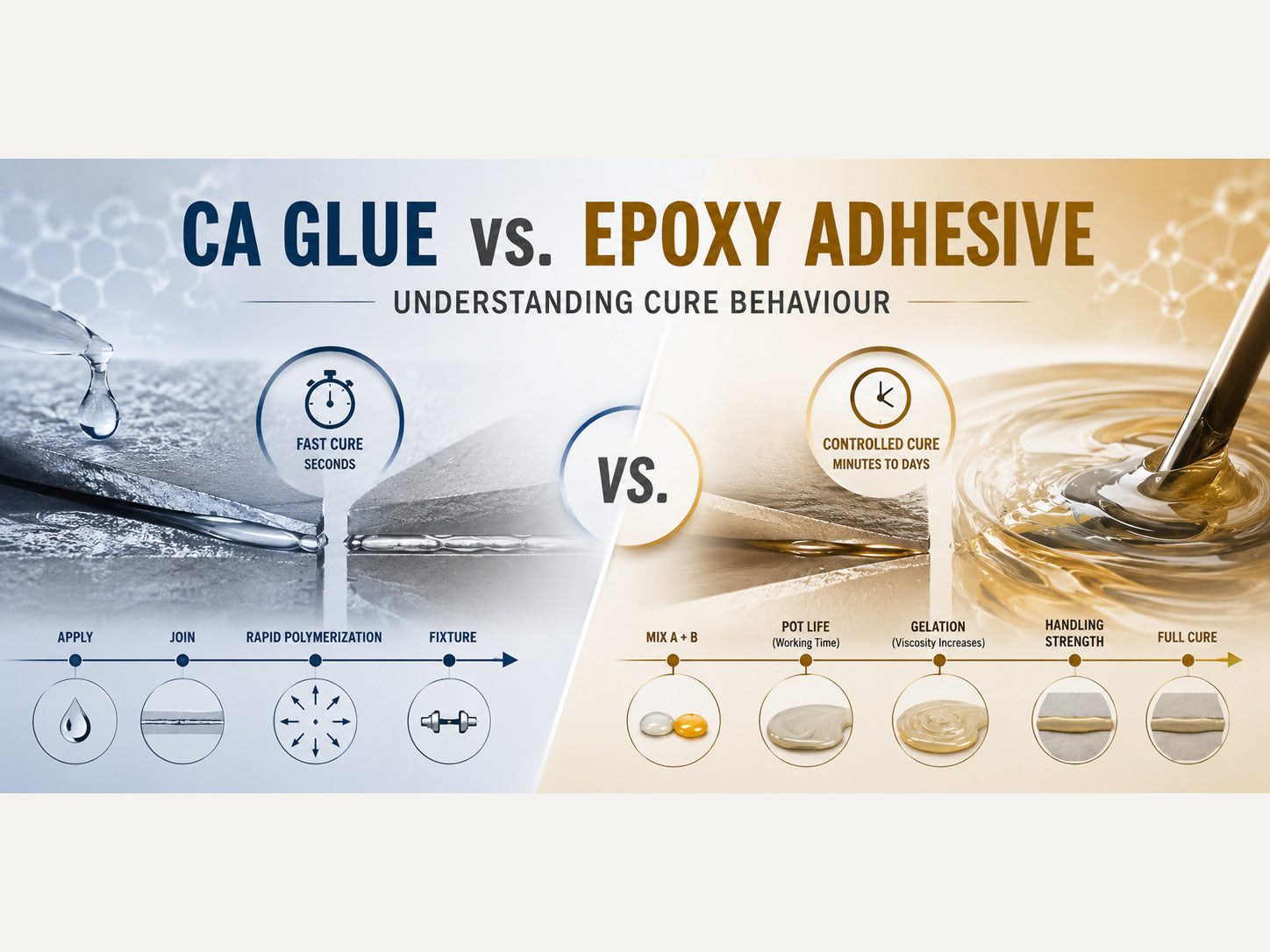
CA (cyanoacrylate) glue and epoxy adhesives can both produce strong bonds, but the way they cure is fundamentally different. Understanding this difference helps explain their working time, fixture time, bond-line limitations, and final performance.
CA Glue: Fast, Surface-Initiated Cure
CA glue is normally a one-component adhesive. It cures when the liquid adhesive contacts small amounts of moisture and other basic species naturally present on most surfaces.
Typical cure behaviour:
Apply → Join surfaces → Rapid polymerization → Fixture → Full cure
The reaction begins at the surfaces and progresses through the adhesive layer. This is why CA adhesives generally perform best in thin bond lines and close-fitting parts.
Depending on the formulation and substrate, initial fixture can occur within seconds, although development of full properties takes longer.
What affects CA cure?
-
Surface moisture and chemistry
-
Bond-line thickness
-
Adhesive viscosity and formulation
-
Substrate type
-
Temperature and humidity
-
Use of an activator
A very thick CA bond line can cure considerably differently from a thin one because the curing mechanism depends strongly on conditions within and around the bond line.
Epoxy: Mixing Starts the Clock
Most structural epoxy adhesives are two-component systems consisting of resin and hardener.
Once the components are mixed, the chemical reaction begins throughout the adhesive:
Mix A + B → Pot life → Gelation → Handling strength → Full cure
Unlike CA glue, epoxy does not normally require surface moisture to initiate curing. Its cure behaviour is mainly controlled by the resin/hardener chemistry, mix ratio, and temperature.
What affects epoxy cure?
-
Resin and hardener chemistry
-
Mix ratio
-
Temperature
-
Mixed quantity and resulting exotherm
-
Bond-line thickness
-
Fillers and additives
An important difference is that epoxy has a defined working or pot life. As the reaction progresses, viscosity increases until the adhesive gels and can no longer be properly applied.
The Cure Profiles Are Very Different
Conceptually, their development of handling strength looks like this:
CA Glue
Applied ┃████████████████ →
Very rapid strength development
Epoxy
Applied ┃░░░▒▒▒▓▓████████ →
Working → Gel → Cure
CA typically develops handling strength very quickly, while epoxy provides a longer working period followed by progressive crosslinking and strength development.
Why Does This Matter?
Choose CA glue when rapid assembly, small bond lines, and fast fixture are priorities.
Choose epoxy adhesive when you need more working time, larger bond lines, gap filling, positioning time, or structural bonding where the adhesive needs time to wet and conform to the surfaces.
Key Takeaway
CA cure is rapid and strongly influenced by the surfaces and bond-line conditions. Epoxy cure begins after mixing and progresses through a controlled chemical reaction between resin and hardener.
Understanding the cure mechanism,not just the advertised “cure time”, helps you choose the right adhesive for the application.

Related Products
Explore CECCORP CA Glue Products
Explore CECCORP Epoxy Adhesive Products


